
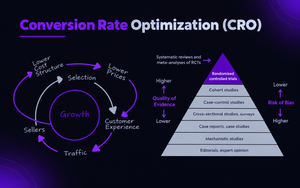
Conversion Rate Optimization (CRO) & Funnel Architecture
SEO Metadata Package
- Target Primary Keyword: B2B funnel conversion optimization
- Secondary Keywords: landing page optimization, micro-conversions, lead capture rate, marketing funnel friction
- Additional SEO Keyword: FREELANCE DIGITAL MARKETER IN KANNUR
- Meta Title: Funnel Architecture: How to Fix Leaks in Your Acquisition Pipeline
- Meta Description: Discover funnel optimization, landing page improvements, and conversion strategies from the FREELANCE DIGITAL MARKETER IN KANNUR.
- Target Audience: Performance marketers, growth leads, and founders
- Estimated Reading Time: 8 minutes
Why Adding More Traffic Won’t Fix a Broken Funnel
When customer acquisition costs (CAC) rise, marketing teams often reflexively ask for more ad budget or more content.
However, pouring high-cost traffic into a low-converting funnel simply accelerates budget waste. If your landing page converts traffic at 1.5%, doubling your ad budget doubles your spend while leaving most visitors untapped. Improving that conversion rate from 1.5% to 3.0% doubles your inbound leads without increasing your media budget, assuming traffic volume and quality remain consistent.
Sustainable growth requires optimizing the micro-conversion steps that bridge the first interaction and a closed sale.
For businesses investing in SEO, Google Ads, and social media marketing, conversion rate optimization is essential for making every marketing effort more effective. The FREELANCE DIGITAL MARKETER IN KANNUR understands that generating traffic is only one part of digital growth; turning visitors into qualified leads and customers is equally important.
Identifying Funnel Friction Across the Customer Journey
Conversion bottlenecks rarely occur only at the final purchase step. They can accumulate across the entire customer journey, from the first advertisement to the final conversion.
| Funnel Stage | Visitor Action | Common Friction Point | High-Impact Fix |
|---|---|---|---|
| Top of Funnel (Attraction) | Ad or organic search click | Misalignment between ad headline and landing page H1 | Match the ad message with the landing page headline |
| Middle of Funnel (Engagement) | Reading a solution page | Dense text and poor visual hierarchy | Use scannable sections, proof points, and clear subheadings |
| Lower Funnel (Action) | Form interaction | Too many mandatory fields | Reduce fields to essential information |
| Post-Conversion (Activation) | Confirmation or thank-you page | Generic confirmation message | Provide a clear next step, booking option, or useful resource |
Identifying these friction points helps marketers make informed improvements instead of spending more money to compensate for an ineffective funnel.
4 Pillars of High-Converting Landing Page Design
1. The Five-Second Value Proposition
Visitors need to understand your offer quickly. Your hero section should answer three important questions without requiring them to scroll:
- What specific outcome do you deliver?
- Who is your service or product designed for?
- What should visitors do next?
Avoid vague taglines such as “Transforming enterprise synergy through automated intelligence.”
Instead, use a clear value proposition such as “Automated sales pipeline reporting for B2B SaaS teams. Reduce manual CRM work and improve sales visibility.”
For service-based businesses, a clear headline that communicates the target audience, service, and benefit can improve landing page relevance and encourage visitors to take action.
2. Frictionless Proof Stacking
Customer trust plays a significant role in conversion decisions. Rather than hiding testimonials and results on a separate page, place relevant proof close to important action points.
- Display genuine client testimonials near the primary Call to Action (CTA).
- Add verified performance metrics near lead-capture forms.
- Showcase relevant case studies that demonstrate how your service solves customer problems.
- Use recognizable client logos only when you have permission to display them.
For freelancers and digital marketing professionals, this approach can help potential clients understand the value of a service before making an enquiry. A FREELANCE DIGITAL MARKETER IN KANNUR can apply these principles to create focused landing pages that communicate value and encourage potential customers to take the next step.
3. Single-Intent Page Architecture
Every marketing landing page should have one clearly defined primary goal. If the objective is lead generation, avoid overwhelming visitors with unrelated links, competing offers, and unnecessary navigation.
Keep the page focused on the offer, its benefits, supporting evidence, and the primary CTA. For campaigns where a dedicated landing page is appropriate, reducing distractions can make it easier for visitors to complete the desired action.
A well-planned digital marketing strategy should ensure that landing page structure aligns with campaign intent, audience expectations, and the service being promoted.
4. Micro-Commitments vs. Cold Asks
Asking an unfamiliar visitor to book a 45-minute product demonstration on their first visit may introduce unnecessary friction. Instead, test lower-commitment entry points that provide immediate value.
- Interactive calculators that deliver useful benchmark reports.
- Self-guided product tours that explain key features.
- Case study previews with an option to access the full report.
- Short enquiry forms that ask only for essential information.
These micro-conversions allow visitors to engage gradually, helping businesses build trust before asking for a larger commitment.
Implementation Checklist
Use this checklist to begin improving your conversion funnel:
- Analyze your funnel: Review Google Analytics 4 (GA4) funnel exploration reports to identify pages or steps with significant drop-offs.
- Simplify your forms: Remove unnecessary fields and retain only the information required to qualify a lead.
- Understand visitor behavior: Use suitable heatmapping and session-recording tools, with appropriate consent and privacy safeguards, to identify usability issues.
- Run controlled A/B tests: Test changes to the main headline or CTA copy before moving on to larger structural redesigns.
- Track meaningful outcomes: Measure qualified leads, completed forms, sales, and conversion rates instead of relying solely on page views.
Prioritize changes based on evidence, and test one meaningful variable at a time whenever possible.
Conclusion: Turn More Visitors into Valuable Customers
Effective conversion rate optimization combines clear messaging, relevant landing pages, customer trust, and a frictionless user experience. By identifying weak points in the marketing funnel and making data-driven improvements, businesses can generate more value from their existing traffic.
Whether you are running Google Ads, improving organic search performance, or promoting services through social media, a well-structured conversion funnel can help turn attention into measurable business results.
If you’re looking for the FREELANCE DIGITAL MARKETER IN KANNUR, Asif can help you explore digital marketing strategies focused on SEO, paid advertising, landing page performance, lead generation, and online growth.
By combining strategic planning with continuous performance analysis, businesses can make smarter marketing decisions and improve their customer acquisition process.
The goal is simple: attract the right audience, remove barriers to conversion, and create a smoother path from the first click to becoming a customer.